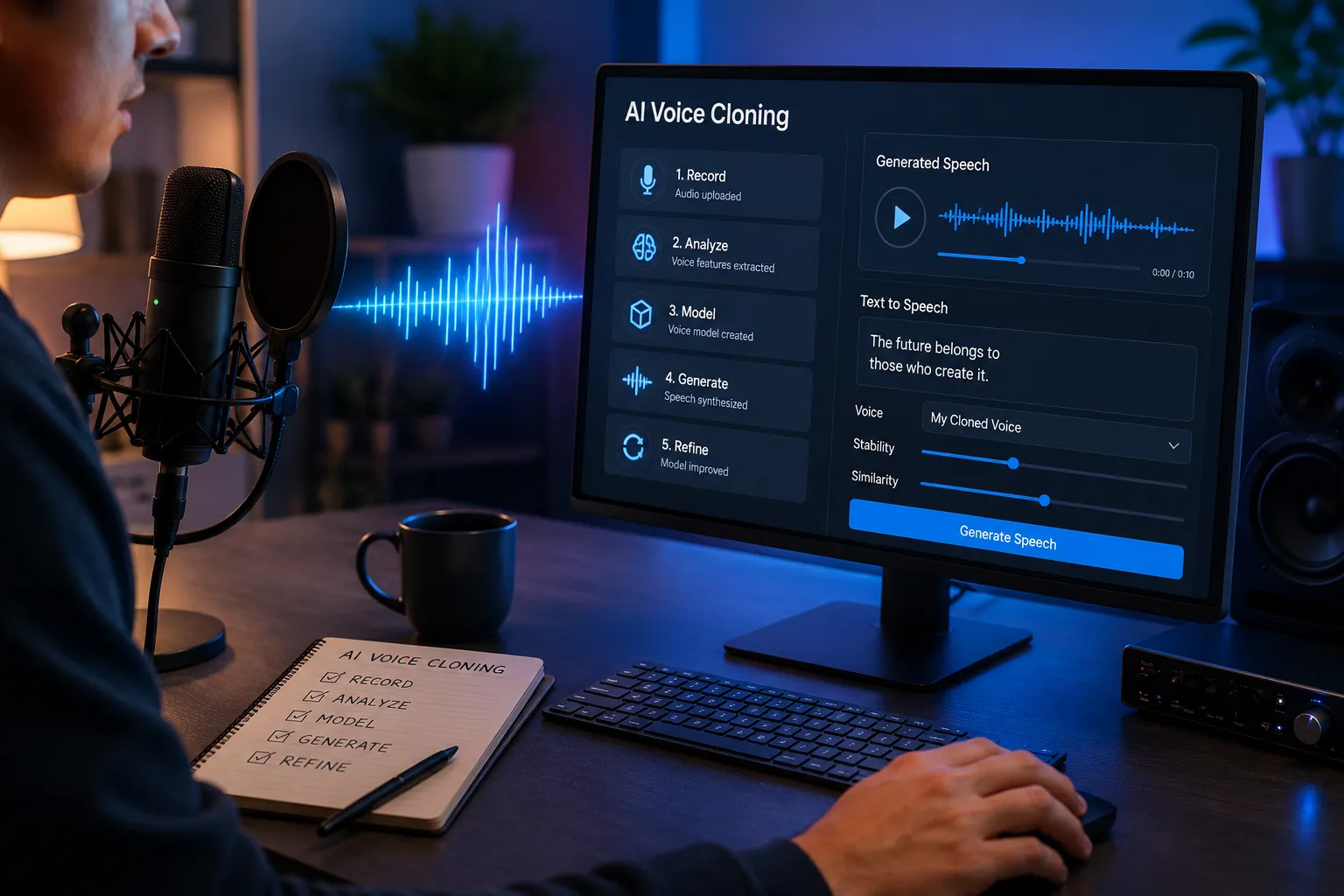
A 30-second voice recording is all a modern AI needs to replicate how someone speaks — accent, tone, emotion, and all. This technology is reshaping content creation, accessibility, and yes, raising serious questions about trust and consent.
30 sec
Audio needed to clone a voice with ElevenLabs
$27B
Global voice AI market projected value by 2025
110+
Languages supported by leading cloning tools
What Is AI Voice Cloning?
AI voice cloning is the process of using machine learning to analyse someone's speech patterns and reconstruct them synthetically — so that the AI can say anything, in that person's voice, from a typed script. The technology captures far more than just pitch and speed. Modern cloning models learn tone, rhythm, emotional cadence, accent, and even the subtle breathing patterns that make a voice feel human.
What was once only possible in high-end film production studios is now accessible via browser-based tools. In 2022, the movie Top Gun: Maverick used AI voice cloning to restore actor Val Kilmer's voice after cancer treatment left him unable to speak clearly. Today, that same level of fidelity is available to anyone with an internet connection.
Under the Hood
How Does the Technology Actually Work?
The process behind AI voice cloning involves several layers working together in sequence:
1. Record
Upload a clear audio sample — 30 seconds to 5 minutes works for most tools.
2. Analyse
Neural networks extract thousands of vocal features — pitch, timbre, cadence, accent.
3. Model
The AI builds a voice model — a mathematical representation of how that voice sounds.
4. Generate
Type any text and the model synthesises speech that sounds like the original speaker.
5. Refine
More audio = better accuracy. Some tools improve the model over time with more samples.
Step-by-Step
How to Clone a Voice Using ElevenLabs (Easiest Method)
ElevenLabs is widely regarded as the gold standard for voice cloning quality in 2025 — reviewers consistently describe its English-language clones as virtually indistinguishable from the real voice. Here's how to get started:
- Go to elevenlabs.io and create a free account.
- Navigate to Voices → Add a new voice → Instant Voice Clone.
- Upload a clear audio sample of the voice you want to clone (MP3 or WAV, at least 30 seconds). Use your own voice, or a voice you have explicit permission to clone.
- Give the voice a name and click Add Voice. Processing takes a few seconds.
- Head to the Text to Speech section, select your new cloned voice, type any script, and click Generate.
- Preview, adjust speaking speed or stability sliders, then download your audio file.
Best Tools 2025
Top AI Voice Cloning Platforms Compared
Best for: Overall quality and realism
The industry benchmark for voice cloning. Captures nuance, emotion, and accent with extraordinary accuracy. The free plan lets you generate limited audio monthly; paid plans unlock higher quality, more voices, and commercial rights. Also supports 29+ languages.
→ Try ElevenLabsBest for: Video creators and marketers
HeyGen goes beyond audio — it clones your voice and syncs it to an AI avatar with lip-sync in one workflow. Paste a script, and the platform generates a video of your AI double speaking it. Supports multiple languages, making it ideal for localising video content at scale.
→ Try HeyGenBest for: Speed and accessibility
Speechify can clone a voice in as little as 30 seconds of audio. It's built around accessibility — turning written content into audio fast. Known for its clean interface and genuinely quick output. The free plan is functional; premium unlocks higher quality and more usage.
→ Try SpeechifyBest for: Quick testing without commitment
TTS.ai offers browser-based voice cloning from a 5–30 second clip with no signup required. Supports emotion controls (happy, sad, neutral) and multiple AI models including Chatterbox and GPT-SoVITS. A great zero-commitment option for first-timers.
→ Try TTS.ai freeBest for: Creators managing full video + audio pipelines
Kapwing integrates voice cloning into a complete video editing suite. Clone a voice, generate the audio, and drop it straight into a video edit — all in one tab. Ideal for YouTube creators or social media managers who need a seamless all-in-one workflow.
→ Try KapwingReal-World Uses
What Are People Actually Using Voice Cloning For?
The legitimate use cases for this technology are genuinely impressive and growing fast:
- Content creators cloning their own voice to narrate videos without re-recording every take
- YouTubers and podcasters translating content into multiple languages while keeping their original voice
- Businesses generating consistent customer service voice responses at scale
- Accessibility tools that let people with speech impairments bank their voice before it deteriorates
- Audiobook narrators generating entire books from a single voice sample
- Educators creating course audio without hours in a recording booth
Read This First
The Ethics and Legal Reality You Can't Ignore
This is the part of the article that matters most. AI voice cloning is powerful — and exactly because it's powerful, it comes with real responsibilities. The legal landscape is still evolving, but the core principles are already well established:
- Cloning your own voice for any use is completely fine — no ethical concerns
- Cloning someone else's voice with their written consent is legal and ethical
- Disclosing to your audience when they are hearing AI-generated audio mitigates most concerns
- Specifying the scope and duration of consent in writing protects both parties
- Cloning a public figure's voice without consent — even for parody — is a legal grey area and ethically problematic
- Using a cloned voice to deceive, defraud, or impersonate someone is illegal in most jurisdictions
- Cloning a voice for commercial gain without consent can result in civil lawsuits (as seen in the Lovo, Inc. case in New York)
- In January 2024, AI-cloned audio of President Biden was used in a fake political robocall — a real example of where misuse leads
Should You Try It?
For content creators, educators, and anyone looking to scale their voice-based work — absolutely. The tools are genuinely impressive, many have free tiers, and the productivity gains are real. Cloning your own voice to handle narration, translation, or repetitive audio tasks is one of the smartest uses of AI available right now.
Just go in with your eyes open about the ethical boundaries. The technology itself is neutral — it's the application that makes it responsible or not. Start with ElevenLabs for quality, TTS.ai if you want to experiment for free, and HeyGen if video is your primary output format.
Published on HyeDraft.com — your everyday guide to tech, health, and modern living.



Comments