
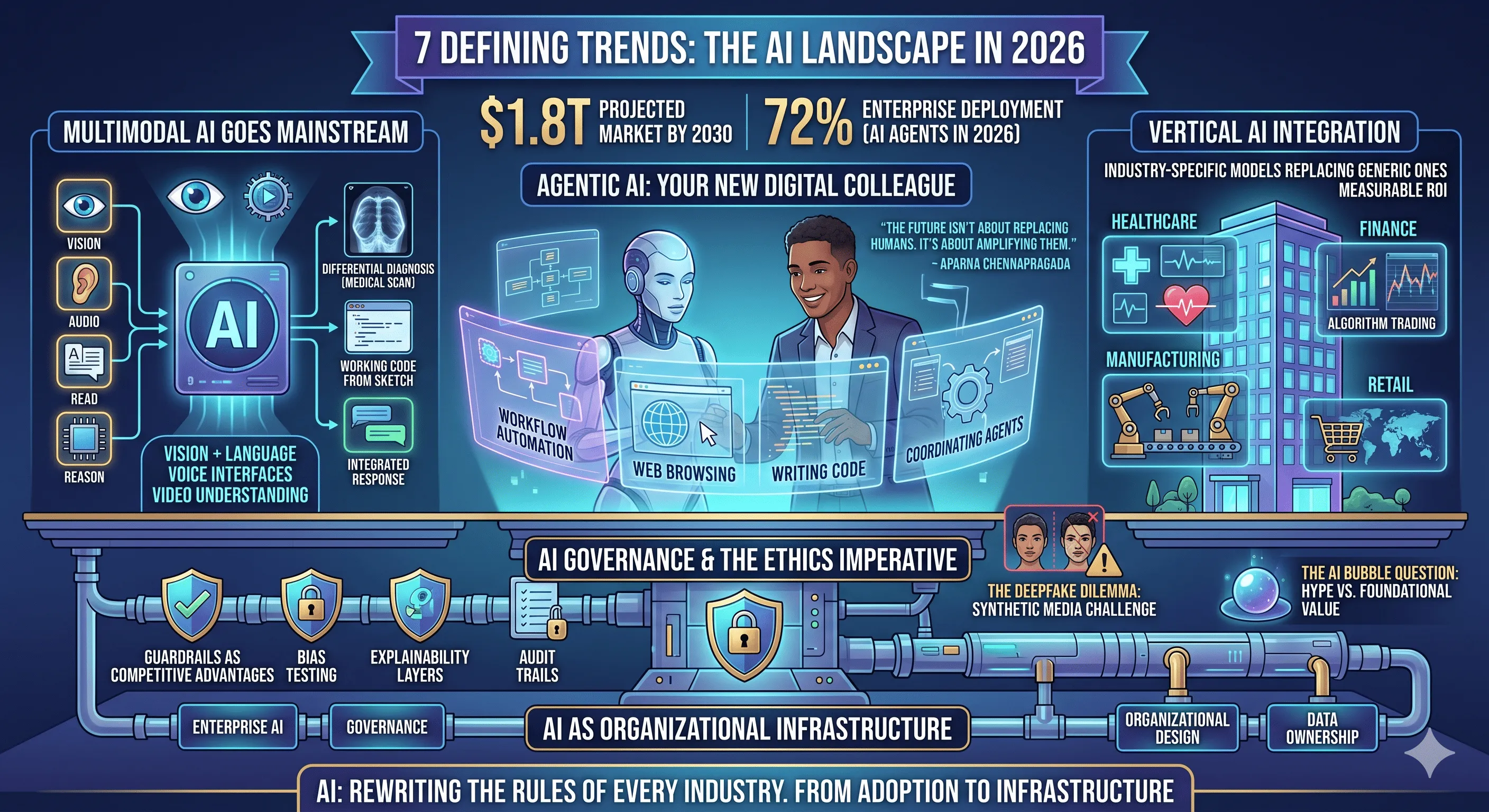
From autonomous digital coworkers to multimodal systems that see, hear, and reason — artificial intelligence is no longer arriving. It's already here, and it's rewriting the rules of every industry.
$1.8T
Projected global AI market by 2030
72%
Enterprises actively deploying AI agents in 2026
7
Defining trends shaping this year's AI landscape
Agentic AI: Your New Digital Colleague
The era of AI answering questions is giving way to AI taking action. Agentic AI systems — capable of executing multi-step tasks, browsing the web, writing code, and coordinating with other agents — are moving from the lab to the office floor. These aren't chatbots. They're autonomous coworkers.
Microsoft's Aparna Chennapragada describes 2026 as a new era of human-AI alliances. "The future isn't about replacing humans," she notes. "It's about amplifying them." Small teams are now punching far above their weight, with AI agents handling research, scheduling, customer outreach, and even software deployment autonomously.
"The future isn't about replacing humans. It's about amplifying them — letting individuals and small teams achieve what only large organizations could before."
— Aparna Chennapragada, Chief Product Officer for AI Experiences, MicrosoftMultimodal AI Goes Mainstream
AI that can see, listen, read, and respond — all at once — has rapidly graduated from research curiosity to commercial reality. Multimodal systems now process images, video, audio, speech, and structured data in unified pipelines. A doctor can upload a scan and get a differential diagnosis. A designer can sketch on a napkin and receive working code.
Experts confirm that multimodal AI is now one of the most important directions in the field. What began as a laboratory achievement is becoming the default interface for enterprise software, customer service, education, and healthcare.
Key trends at a glance
Vertical AI integration
Industry-specific models replacing generic ones
Healthcare, finance, manufacturing, and retail are deploying AI trained exclusively on their domain data — outperforming general models by wide margins. From AI receptionists in hospitals to algorithmic trading systems in banks, vertical AI is delivering measurable ROI where broad models fall short.
AI governance and the ethics imperative
Guardrails are becoming competitive advantages
As AI grows more powerful, the conversation has matured from "will it work?" to "should it do this?" Regulatory frameworks are tightening globally, and organizations that bake responsible AI practices into their stack — bias testing, explainability layers, audit trails — are finding these to be trust-building differentiators, not just compliance burdens.
The deepfake dilemma
Synthetic media is AI's most urgent social challenge
Deepfakes — convincingly realistic synthetic audio and video — remain one of the most pressing AI challenges in 2026. Misinformation, fraud, and reputational attacks powered by AI-generated content are escalating, forcing platforms, governments, and enterprises into an arms race with detection and watermarking technologies.
The AI bubble question
Is the hype sustainable?
MIT Sloan analysts Davenport and Bean name the potential deflation of the AI bubble as this year's elephant in the room. Massive infrastructure investments, soaring valuations, and uneven returns are prompting serious questions. However, the consensus is that foundational value creation is real — even if some of the froth is not.
AI as Organizational Infrastructure
The final — and perhaps most transformative — shift is how businesses are rethinking AI ownership. Early adoption was individual: a developer using Copilot, a marketer prompting ChatGPT. In 2026, forward-looking organizations are building AI into shared infrastructure — centralized models governed, maintained, and audited like any other critical system.
This reframing from personal productivity tool to organizational resource is changing how IT, legal, HR, and the C-suite collaborate around AI. The question is no longer who has access to AI — it's who is accountable for it.



Comments