
For years, America assumed it owned the future of artificial intelligence. Silicon Valley had the best labs, the biggest models, and the deepest pockets. The world's top AI talent flocked to the United States. It felt like a race with only one serious runner.
That story is over.
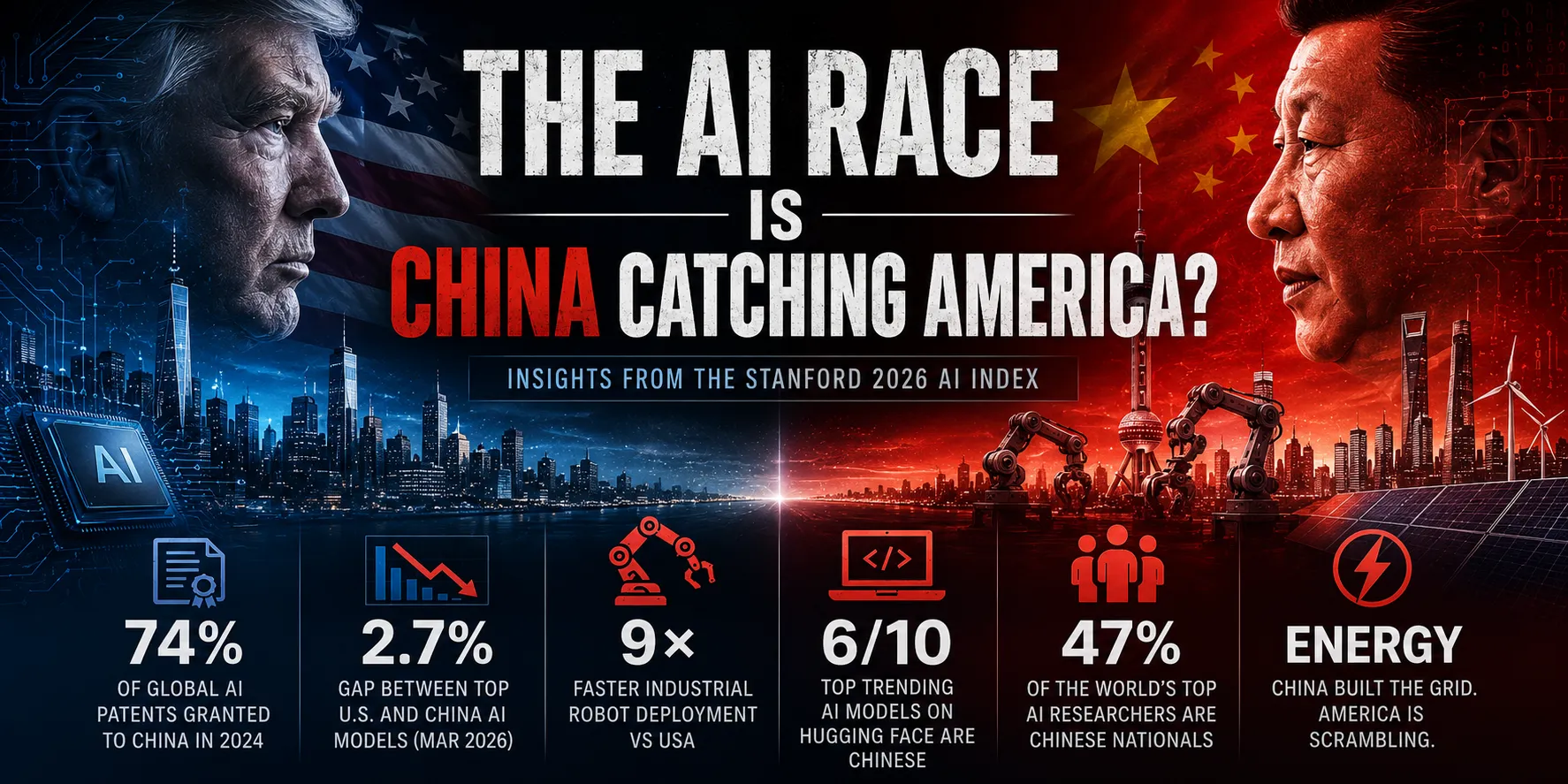
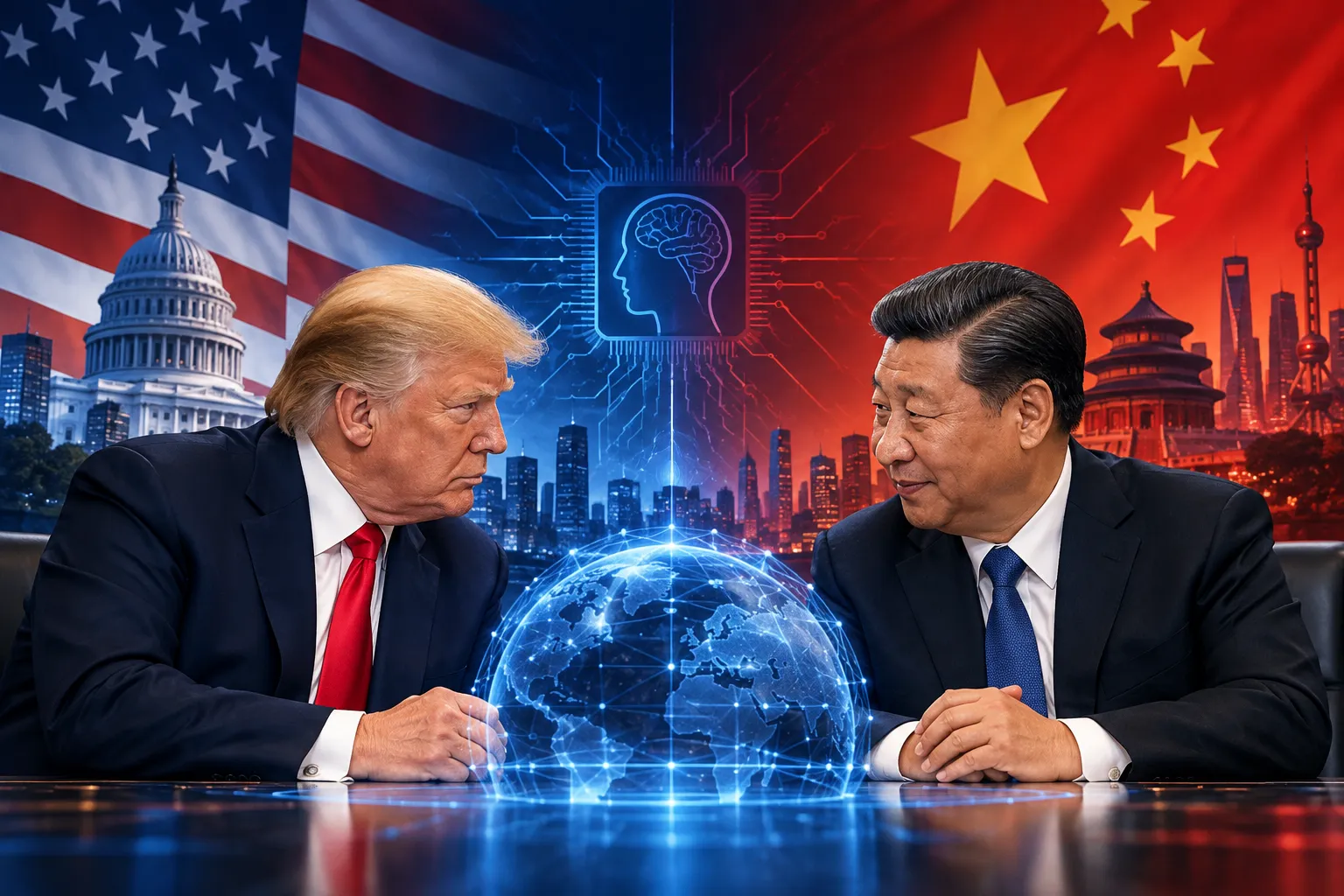
According to Stanford University's 2026 AI Index — one of the most respected annual reports on the state of global AI — China has "nearly erased" America's lead. The gap between the top U.S. and Chinese AI models, which was enormous in 2023, had shrunk to just 2.7% by March 2026. The crown is slipping. And the reasons why are worth understanding clearly.
Why China Is Winning
1. China Had a Plan. America Had a Market.
Most countries started scrambling for an AI strategy after ChatGPT launched in late 2022. China had already been running its national AI playbook for five years by then.
In July 2017, the State Council released China's "Next Generation Artificial Intelligence Development Plan" — a sweeping document that set 2030 as the target year for becoming the world's premier AI power. It was backed by billions in government funding, policy reforms, and direct private-sector alignment. Every city, every university, every major company was pointed in the same direction.
America, by contrast, left AI development largely to the private sector. That produced brilliant innovation — but no unified national strategy, no coordinated deployment, and no long-term industrial plan. China played chess while America played poker.
2. China Dominates Research and Patents
The numbers from Stanford's 2026 AI Index are striking. China now leads the world in AI research publications and citations. In 2024, China represented over 74% of the world's AI patent grants. The United States accounted for just 12%.
"America's AI patents are highly concentrated among a small set of large private firms — meaning the country's innovation is narrow, not broad."
— International economists, 2026China, meanwhile, is filing AI patents across manufacturing, robotics, healthcare, logistics, agriculture, and government — building an intellectual property base that covers the entire economy, not just a handful of tech giants.
3. Open Source vs. Closed Doors
America's leading AI labs — OpenAI, Anthropic, Google DeepMind — have built powerful but proprietary, closed systems. Access costs money. Building on top of them costs money.
China made the opposite bet. Chinese AI labs flooded the world with open-source models that anyone can download, use, and build on for free. By August 2025, Chinese open-source models held six of the top ten trending spots on Hugging Face, the world's leading AI model repository. Chinese models are also up to four times cheaper than comparable American alternatives.
The result: developers worldwide are building on Chinese AI foundations. China is winning the infrastructure war quietly, one download at a time.
4. The Talent Drain Is Going the Wrong Way
America built its AI dominance partly on attracting the world's best minds. International students came to U.S. universities, stayed, and built companies like Google and OpenAI. That model is breaking down.
A 2025 Hoover Institution and Stanford HAI report found that nearly all the researchers behind DeepSeek's breakthrough papers were educated or trained in China. A quarter of them did attend U.S. institutions — but then returned home, creating what Stanford called a "one-way knowledge transfer" in China's favor.
- 47% of the world's top AI researchers are Chinese nationals
- 50%+ of global AI patents filed by Chinese entities
- 36% of all global AI research publications from Chinese institutions
- China accounts for 20.6% of AI citations vs U.S.'s 12.6%
5. Deployment at Scale: China Builds, America Debates
China is deploying industrial AI-integrated robots at nearly nine times the rate of the United States. It is embedding AI into factories, hospitals, courts, logistics networks, and smart cities at a scale no Western democracy has attempted.
Every deployed system generates real-world data. That data trains the next generation of AI. The flywheel spins faster every year. America, by contrast, is still debating — regulatory uncertainty, privacy concerns, permitting battles over data centers, and political gridlock slow deployment at every turn.
6. Energy: China Built the Grid. America Is Scrambling.
AI is extraordinarily power-hungry. Training large models and running massive data centers requires enormous electricity — and the U.S. power grid was not built for this demand. American AI companies are scrambling: OpenAI announced a billion-dollar energy alliance, Microsoft is attempting to restart Three Mile Island nuclear plant, Meta is exploring space-based solar energy.
China does not have this problem. It has been the world's largest energy producer since 2010. In 2025 alone, China added over 540 gigawatts of new power capacity — roughly 80% solar and wind. Over four years, China built the equivalent of the entire U.S. power grid in new capacity.
"Of all the key inputs into AI, energy is the one where the U.S. is least competitive."
— AI Futures Project analyst, 2026Where America Still Leads
To be fair, the U.S. has not lost the AI race — not yet. American frontier models still lead China's best by a narrow margin in raw performance. U.S. private investment in AI dwarfs China's: America spent $258.9 billion on AI in 2025, compared to China's $12.4 billion. Nvidia's chips remain the gold standard for AI training, and America controls that chokepoint entirely.
America's hyperscalers — Google, Amazon, Microsoft, Meta — plan to spend $650 billion on AI infrastructure in 2026 alone. The U.S. still leads in raw frontier model capability. The question is whether money alone can sustain that lead.
But here is the hard truth: spending more money is not automatically winning. China has repeatedly demonstrated that it can do more with less — building competitive AI models at a fraction of the cost, deploying AI across an entire economy on constrained hardware, and generating real-world data advantages that money cannot simply buy.
The Bottom Line
America invented the internet. America invented the smartphone era. America assumed it would invent the AI era too — and coast.
China never assumed anything. It planned. It invested. It deployed. It trained a generation of researchers, flooded the world with open-source models, built the power grid for the AI age, and kept its best talent at home.
The Stanford 2026 AI Index said it plainly: "For years, the U.S. outpaced all other global regions on AI — in model size, performance, research, citations, and more. But China emerged as an AI counterweight to the U.S., gradually gaining ground, and this year it appears to have nearly erased any U.S. lead."
The race is not over. But America can no longer afford to treat it as already won.


Comments