
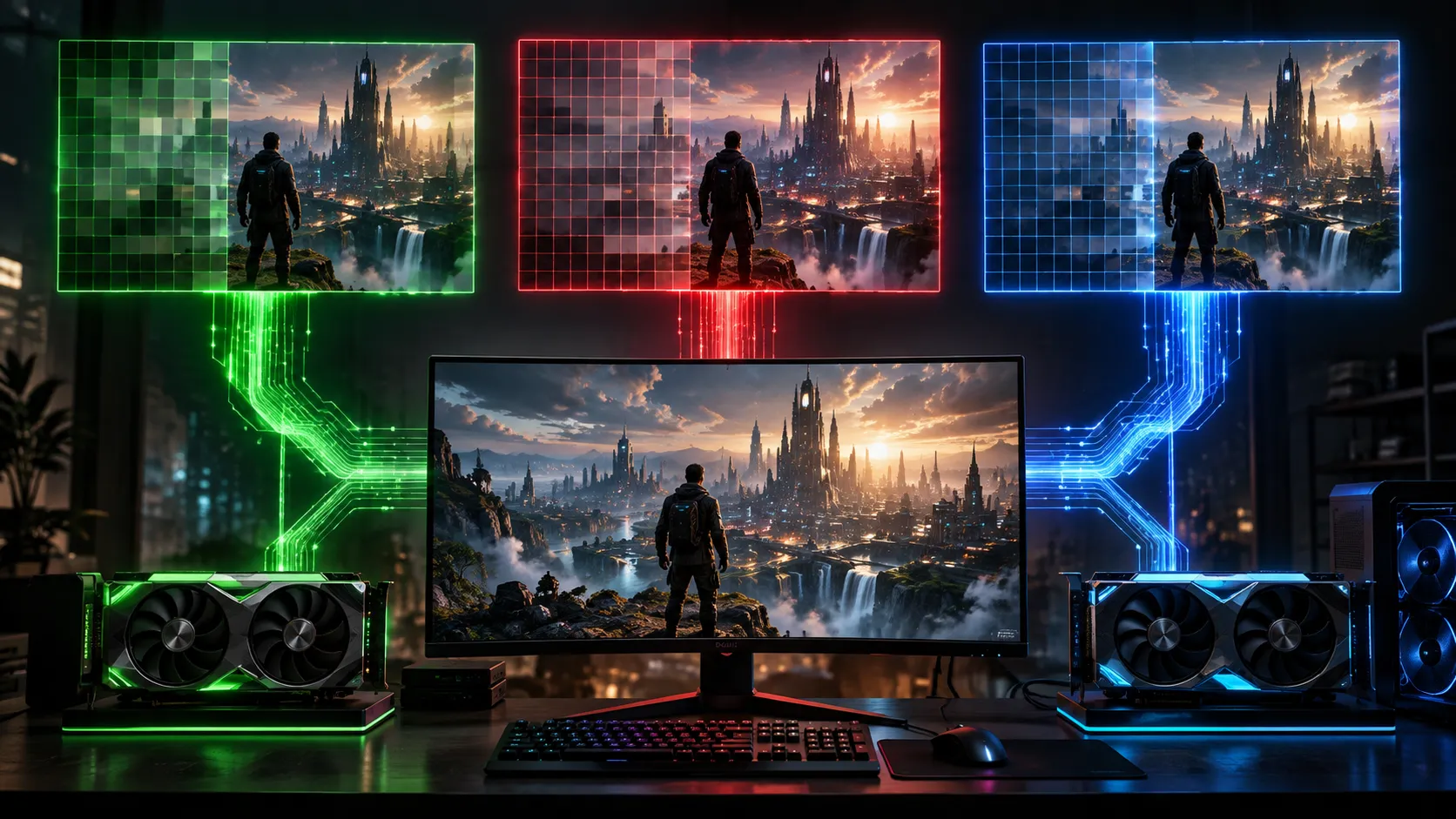
If you are weighing DLSS 5 vs FSR and XeSS in 2026, here is the short version: AMD and Intel have largely caught up with Nvidia on classic upscaling and frame generation, but Nvidia is now competing on something different. DLSS 5 uses neural rendering to change how lighting and materials look, and AMD's answer is reportedly tied to next-generation RDNA 5 hardware that may not ship until 2027 or later.
Below we break down what each vendor offers today, where the real gaps are, and what the rumoured AMD approach could mean for your next graphics card.
Key takeaways
- Upscaling is roughly a tie now. FSR 4 and 4.1 switched to machine learning, closing most of the image-quality gap with DLSS.
- Nvidia still leads on frame generation multipliers, though AMD is testing a multi-frame mode in drivers that could leapfrog it.
- DLSS 5 is not a performance feature. It repaints lighting and surfaces with AI, costs frame rate, and has split gamers and developers.
- AMD's DLSS 5 rival is only a leak so far, and it may be exclusive to RDNA 5 GPUs.
- Older Radeon owners are gaining ground: FSR 4.1 has already reached RX 7000 cards, with RDNA 2 support planned for early 2027.
What DLSS 5 actually changes
When Nvidia launched Deep Learning Super Sampling in 2018, the goal was simple: render fewer pixels, then let a neural network rebuild a sharp, high-resolution frame. Every version since has stacked something on top of that idea. DLSS 2 turned it into a general-purpose reconstruction system, DLSS 3 added generated frames, DLSS 3.5 brought Ray Reconstruction, and DLSS 4 introduced Multi Frame Generation.
DLSS 5 breaks the pattern. Instead of chasing more frames per second, it applies what Nvidia calls 3D-guided neural rendering. The model reads data from each rendered frame, such as surface normals, albedo, lighting, colour and motion vectors, and uses it to produce richer lighting and material responses. Skin and hair are the headline targets, which is where traditional real-time rendering tends to look most artificial.
There are strings attached. A game has to support DLSS 5 directly, and developers get controls to dial the effect up or down so their art direction survives. NBA 2K27 is the first title to ship with it. You can follow Nvidia's official feature list on the DLSS technology page.
Why DLSS 5 is controversial
Critics argue that DLSS 5 behaves more like a photorealism filter than a rendering aid. Because it uses generative AI to reinterpret lighting, textures and colour, it can drift away from the look the original artists chose. It also carries a noticeable performance cost, which is the opposite of what DLSS was created to do. Supporters counter that, with sensible developer limits, it could make games look closer to how we imagine them.
DLSS 5 vs FSR and XeSS: feature by feature
To judge the DLSS 5 vs FSR debate fairly, it helps to separate the stack into layers. Here is how the three vendors line up in late 2026, based on current public information.
| Feature | Nvidia DLSS | AMD FSR | Intel XeSS |
|---|---|---|---|
| AI upscaling | Yes, since the first version | Yes, from FSR 4 (FSR 1 and 2 were non-ML) | Yes, since launch in 2022 |
| Frame generation | Multi Frame Generation; DLSS 4.5 adds up to five generated frames | 2X in FSR 4.1; up to 8X being tested for RDNA 4 | Up to 4X with XeSS 3 |
| AI ray-tracing denoiser | Ray Reconstruction (DLSS 3.5+) | Ray Regeneration (FSR Redstone) | No equivalent |
| Learned lighting cache | Neural Radiance Cache | Radiance Caching (FSR Redstone) | No equivalent |
| Neural rendering of materials and lighting | DLSS 5 (per-game support) | Rumoured for RDNA 5 | Nothing announced |
Upscaling: the gap has closed
AMD took four generations to get here. The first FSR, released in 2021, was a purely spatial algorithm and looked noticeably worse than DLSS. FSR 2 moved to a temporal design that borrowed information from earlier frames, and FSR 4 finally adopted machine learning. FSR 4.1 then refined temporal stability and dynamic lighting. In direct comparisons, DLSS 4.5 still tends to produce the crispest image, while FSR 4.1 looks a little softer and more natural and often runs faster.
Intel's XeSS started with AI upscaling from day one alongside the first Arc cards, but it arrived late, supports fewer games, and can be heavier to run. It works on GPUs from any vendor, although the newest versions rely on the XMX matrix cores found in Arc hardware.
Frame generation: Nvidia ahead, for now
Generated frames are where Nvidia built its biggest lead, and it still holds the highest shipping multiplier. That lead may be short-lived. Reports from VideoCardz indicate recent AMD drivers contain a test build of multi-frame generation for RDNA 4 that reaches 8X. If that ships, Radeon would briefly hold the higher number.
Ray tracing denoisers: AMD catches up, Intel does not
AMD's FSR Redstone package bundles two ray-tracing helpers. Ray Regeneration cleans up noisy ray-traced lighting, reflections and shadows, while Radiance Caching predicts how light bounces through a scene rather than tracing every ray from scratch. Both are exclusive to RDNA 4 GPUs. Intel currently has no answer in this category.
AMD's rumoured DLSS 5 rival on RDNA 5
According to well-known hardware leaker Kepler_L2, AMD is developing its own neural rendering feature for the RDNA 5 architecture, a technique that swaps parts of the traditional shader pipeline for neural networks. Hinting that it may stay locked to new hardware, the leaker wrote: Probably, this stuff is pretty heavy.
(via TweakTown).
Kepler_L2 also laid out how they believe the feature should work to avoid the "AI slop" look some players associate with DLSS 5:
- Feed the model real 3D data such as geometry and BVH structures, ray data, depth buffers and material information, so it knows how objects respond to light instead of guessing from a flat image.
- Split lighting and shading into two separate models, one for lighting improvements and one for complex surfaces like skin.
- Drop AI colour grading entirely, leaving the palette the artists picked untouched.
It is important to treat this as the leaker's wish list, not AMD's confirmed design. Timing is also uncertain: RDNA 5 is not expected before mid-2027, and some partner chatter points to 2028.
Good news for older Radeon cards
While the neural rendering race plays out, AMD has been widening access to its existing tech. FSR 4.1 was originally tied to the Radeon RX 9000 series, but in June 2026 AMD brought it to RDNA 3-based RX 7000 cards ahead of its July target. AMD says it is also adapting the upscaler for RDNA 3 APUs and plans to bring it to RDNA 2 graphics cards in early 2027. You can check supported games on AMD's FidelityFX Super Resolution page.
Could neural rendering revive classic games?
One of the more exciting ideas around DLSS 5 has nothing to do with new releases. Plenty of PC gamers would love to replay classics like The Elder Scrolls III: Morrowind or Star Wars: Knights of the Old Republic with modern lighting, without a full remake that changes the characters or art style. Minecraft with ray tracing already shows how much better lighting alone can lift an old-looking game.
The catch is that DLSS 5 needs per-game integration, so old titles will not benefit automatically. For now, the more practical route is Nvidia RTX Remix, which lets modders swap assets and add path tracing to supported older games without touching the original engine.
Which GPU should you buy?
- You want the best image quality today: Nvidia RTX still has the most polished upscaler and the widest game support.
- You care about value and frame rate: a Radeon RX 9000 card with FSR 4.1 and Redstone now covers almost every performance feature Nvidia offers.
- You own an RX 7000 or RX 6000 card: hold on. FSR 4.1 already works on RX 7000 GPUs, and RDNA 2 support is planned.
- You are waiting for neural rendering: do not buy hardware for DLSS 5 alone until more games support it and reviews settle the art-style debate.
For more buying advice, browse our hardware coverage and our AI explainers.
Frequently Asked Questions
Is DLSS 5 better than FSR 4.1?
They solve different problems. FSR 4.1 is an upscaler and frame generator that competes with DLSS 4.5. DLSS 5 is a neural rendering feature that changes lighting and materials, and AMD has no shipping equivalent yet.
Does AMD have a DLSS 5 alternative?
Not officially. A leak suggests AMD is building neural rendering for RDNA 5 GPUs, possibly exclusive to that hardware, with a launch unlikely before mid-2027.
Which games support DLSS 5?
NBA 2K27 is the first launch title. Every game needs to integrate DLSS 5 directly, so support will grow title by title.
Can I use FSR 4.1 on an RX 7000 series card?
Yes. AMD released FSR 4.1 for RDNA 3-based RX 7000 GPUs in June 2026, earlier than planned. RDNA 2 cards are scheduled for early 2027.
Does Intel XeSS have frame generation?
Yes. XeSS 3 supports frame generation of up to 4X, but Intel has no ray-tracing denoiser or neural rendering feature to rival Nvidia and AMD.
Final thoughts
The DLSS 5 vs FSR question is no longer about who can squeeze out more frames. AMD and Intel have matched most of the performance toolkit, and Nvidia has moved the fight to AI-driven visuals instead. Whether that becomes the next standard or a divisive optional filter depends on how developers use it and on what AMD delivers with RDNA 5. Until then, buy a GPU for the upscaling and frame generation you can use today.






Comments