
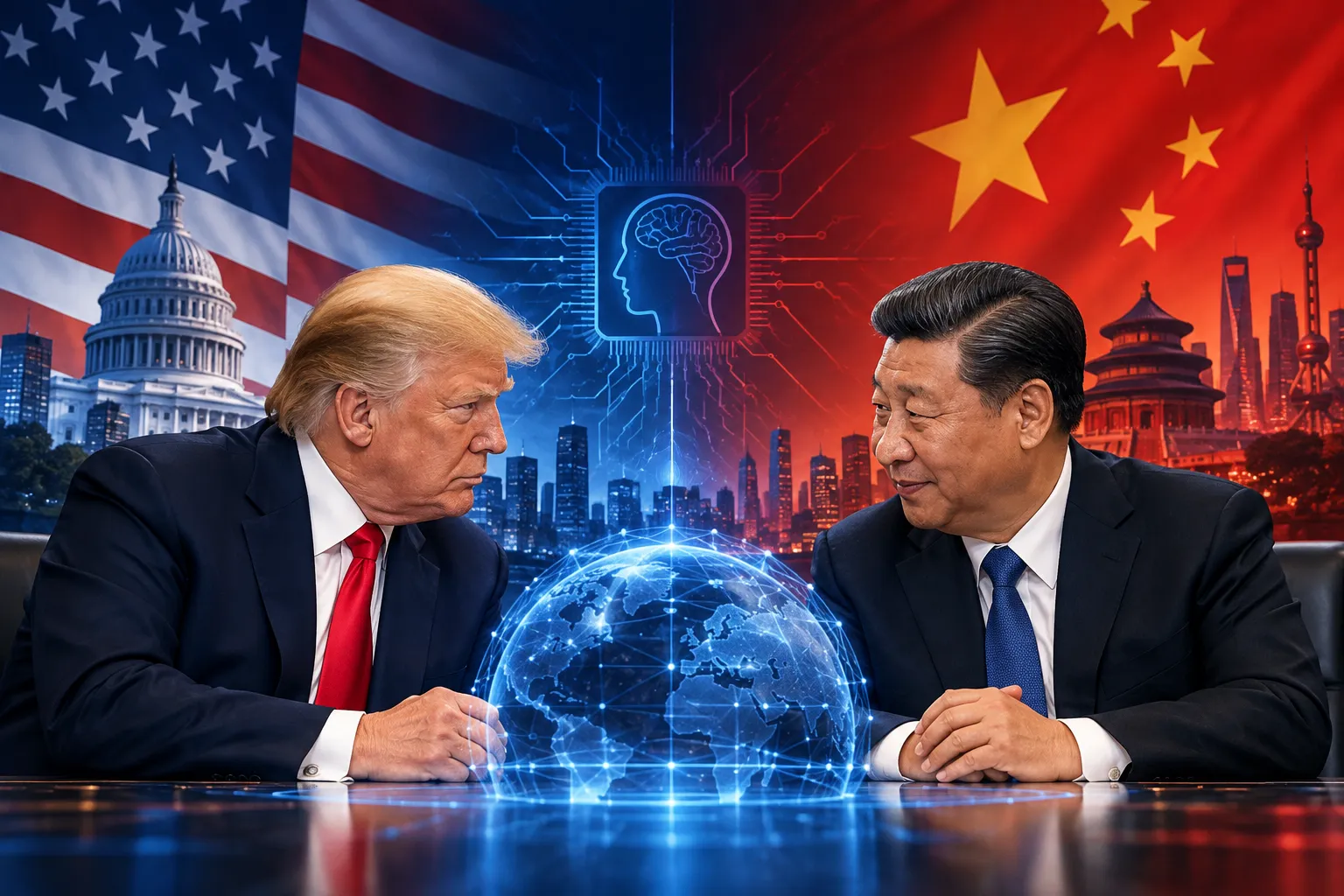
The United States and China have agreed to build a US-China AI safety channel, a dedicated line for handling incidents involving artificial intelligence, after a three-day state visit by Xi Jinping to Washington. A focused AI dialogue is set for November. Neither side called it a breakthrough, but it is the first time the two AI superpowers have committed to a standing mechanism specifically for AI risk.
Alongside the AI pledge, the two governments said they would speed up work on military crisis communications and keep trade talks moving. Here is what was agreed, what was not, and why analysts think the small steps matter.
Key takeaways
- A communication mechanism for AI-related incidents will be created, with an AI-focused dialogue scheduled for November.
- The two militaries will sign a memorandum of understanding on crisis communication and prevention.
- A bilateral Board of Trade started work this week, and a trade truce was extended by two months.
- President Trump said the US will not slow its AI development and will limit what it shares with Beijing.
- Rare earths, tariffs, Iran and fentanyl were all on the table; fundamental disagreements remain.
What is the US-China AI safety channel?
According to the readouts released on Saturday by both governments, each side will set up a communication mechanism to deal with incidents linked to AI and to discuss the technology's risks and benefits. China's Foreign Ministry published only a short, one-page statement, so the practical details (who staffs the channel, what counts as an "incident", how fast it responds) are still unknown.
The idea mirrors the hotlines built during the Cold War to stop misunderstandings from spiralling. With AI now embedded in cyber operations, surveillance, military planning and critical infrastructure, a malfunction or misattributed attack could escalate quickly. A pre-agreed line gives officials a way to ask "was that you?" before anyone reacts.
For background on how the rivalry has evolved, see this overview of China–United States relations.
Cooperation, but no sharing of the AI lead
Speaking to reporters at the White House after the summit, Trump made clear the channel is about managing risk, not pooling research. He argued that the US holds a lead of at least a year over China, possibly more, and said Washington has no intention of opening up its work or easing off. In his words, the US would not be "putting on brakes," as the Associated Press reported.
That framing matters. It suggests the AI line will look more like a safety valve for accidents and misunderstandings than a joint governance framework. Anyone hoping for shared standards on frontier models, compute limits or chip exports will need to wait for the November dialogue, and possibly much longer.
Military crisis communications get an upgrade
Beijing's readout says the two countries will sign an MoU aimed at strengthening crisis communications and preventing crises between their armed forces. Military-to-military contact has been patchy for years, often suspended during diplomatic disputes. Formalising it in writing is designed to keep the lines open even when relations sour.
Trade, tariffs and rare earths
Trade dominated much of the summit even without a grand bargain. The main points:
| Issue | What was agreed or said |
|---|---|
| Board of Trade | A new body for selected bilateral trade issues; the White House says it began operating this week. |
| Trade truce | Extended by two months. |
| Tariffs | Continued work on cutting reciprocal tariffs covering about $30 billion of goods, mostly non-sensitive items such as farm products and holiday decorations. |
| Coal | China will buy at least 10 million metric tons of US coal in both 2027 and 2028, per the White House. |
| Rare earths | Talks continue on restoring shipments to appropriate levels after China's export controls last year. |
The rare earths item is the one to watch for the tech industry. These minerals feed into magnets, motors, electronics and defence hardware. China restricted exports last year in retaliation for US tariffs, squeezing supply to the US and other buyers. Any easing would ripple through chip, EV and hardware supply chains. For more on why these materials matter, see the rare-earth element explainer.
Iran, shipping lanes and fentanyl
Both governments said Iran should keep its stated commitment not to build nuclear weapons. They also agreed that no country should impose tolls on international waterways, an apparent nod to the Strait of Hormuz, where shipping has dropped sharply since the US war with Iran began.
On drugs, the US welcomed China's decision to put export controls on two more precursor chemicals used to make fentanyl, and both sides pointed to recent arrests in related cases.
What happens next
- November: the dedicated AI dialogue, plus a leaders' meeting at the APEC summit hosted in Shenzhen.
- Later: another meeting at the G20, which the US will host at Trump National Doral in Miami.
- Ongoing: Board of Trade work on tariffs and rare earths.
Why it matters
The summit did not resolve the deep disputes over technology controls, Taiwan or trade balances. What it did was build plumbing. Working groups, hotlines and scheduled dialogues are unglamorous, but they make it harder for a single incident to blow up into a crisis. Wang Zichen, deputy secretary-general at the Center for China and Globalization think tank in Beijing, described the emphasis on working-level and military contacts as an attempt to make stability more durable and institutionalized, rather than dependent on two leaders getting along.
For the AI world specifically, a formal US-China channel is a first step toward the kind of international incident reporting that researchers have long called for. Whether it becomes meaningful depends on what the November talks put inside it. Follow our AI news coverage for updates.
Frequently Asked Questions
What did the US and China agree on AI?
They agreed to create a communication mechanism for AI-related incidents and to discuss AI risks and benefits, with a dedicated dialogue planned for November.
Will the US share AI technology with China?
No. Trump said Washington will limit what it shares and will not slow its own AI development, arguing the US is ahead.
Did the summit end the US-China trade war?
Not entirely. The leaders extended a trade truce by two months, launched a Board of Trade and kept working on tariff cuts and rare earths supply.
When will Trump and Xi meet again?
They plan to meet at the APEC summit in Shenzhen in November and later at the G20 in Florida.
Final thoughts
The new US-China AI safety channel will not settle the race for AI leadership, and neither side pretends it will. But as AI systems become more powerful and more entangled with security, having an agreed way to talk when something goes wrong is a sensible minimum. November's dialogue will show whether it is a real safeguard or a symbolic gesture. For wider tech context, browse our technology section.




Comments