

New Gartner research cuts through the panic: AI layoffs are real, but they're not paying off. The firms winning the AI race aren't replacing workers — they're amplifying them.
Based on Gartner Reports, 2025–2026
12 min read
Workforce & AI Strategy
"AI is not about job loss. It's about workforce transformation."
— Gartner Distinguished VP Analyst
Every few months, a new headline declares that AI is coming for your job. Robots will replace the analysts. Agents will displace the developers. Automation will hollow out the middle class. It's a compelling story — and like most compelling stories, it's more complicated than the headline suggests.
Gartner, the global research and advisory firm that surveys thousands of executives and workers worldwide, has been tracking AI's actual impact on employment with rigorous data. Their findings don't quite match the apocalyptic narrative — but they don't offer pure comfort either. The picture is more nuanced, more demanding, and ultimately more hopeful than the fear-mongers suggest.
The Numbers That Actually Matter
Let's start with the hard data. Gartner's latest research surveys paint a clear picture of where we are — and where we're heading.
0%
IT work done by humans without AI by 2030, per CIO survey
75%
IT work done by humans augmented with AI by 2030
25%
IT work performed by AI alone by 2030
500M+
Net new human jobs projected by 2036 from AI augmentation
These numbers, drawn from Gartner's survey of over 700 CIOs conducted in July 2025, tell a story of transformation — not elimination. By 2030, every single piece of IT work will involve AI in some capacity. But three-quarters of it will still be driven by humans, just humans working alongside intelligent tools.
"AI will make some skills — such as summarization, information retrieval and translation — less important. But AI also creates a need for entirely new skills."— Gartner Analyst, IT Symposium/Xpo 2025
The Layoff Illusion: Why Cutting Jobs Isn't Cutting It
Here's where the story gets genuinely surprising. Gartner surveyed 350 global business executives in Q3 2025 — all from companies with at least $1 billion in revenue that had deployed AI agents, intelligent automation, or autonomous technologies. Approximately 80% reported workforce reductions.
That sounds alarming. But here's the twist: those reductions aren't working.
Gartner's analysis found that workforce reduction rates were nearly equal among companies reporting high ROI from AI and those reporting modest gains or negative outcomes. In other words, laying people off doesn't make your AI investments pay off. The companies actually winning? The ones amplifying their people, not replacing them.
"Workforce reductions may create budget room, but they do not create return. Organisations that improve ROI are not those that eliminate the need for people, but those that amplify them."— Helen Poitevin, Distinguished VP Analyst, Gartner
Even more telling: Gartner's research found that in the second half of 2025 — supposedly the peak of the "Great AI Layoff" — only 9% of global worker reductions were actually attributable to AI. The rest? Organic business decisions, restructuring, post-pandemic overcorrections, and, in some cases, what Sam Altman himself called "AI washing" — blaming AI for layoffs that would have happened anyway.
The Four Futures of Work
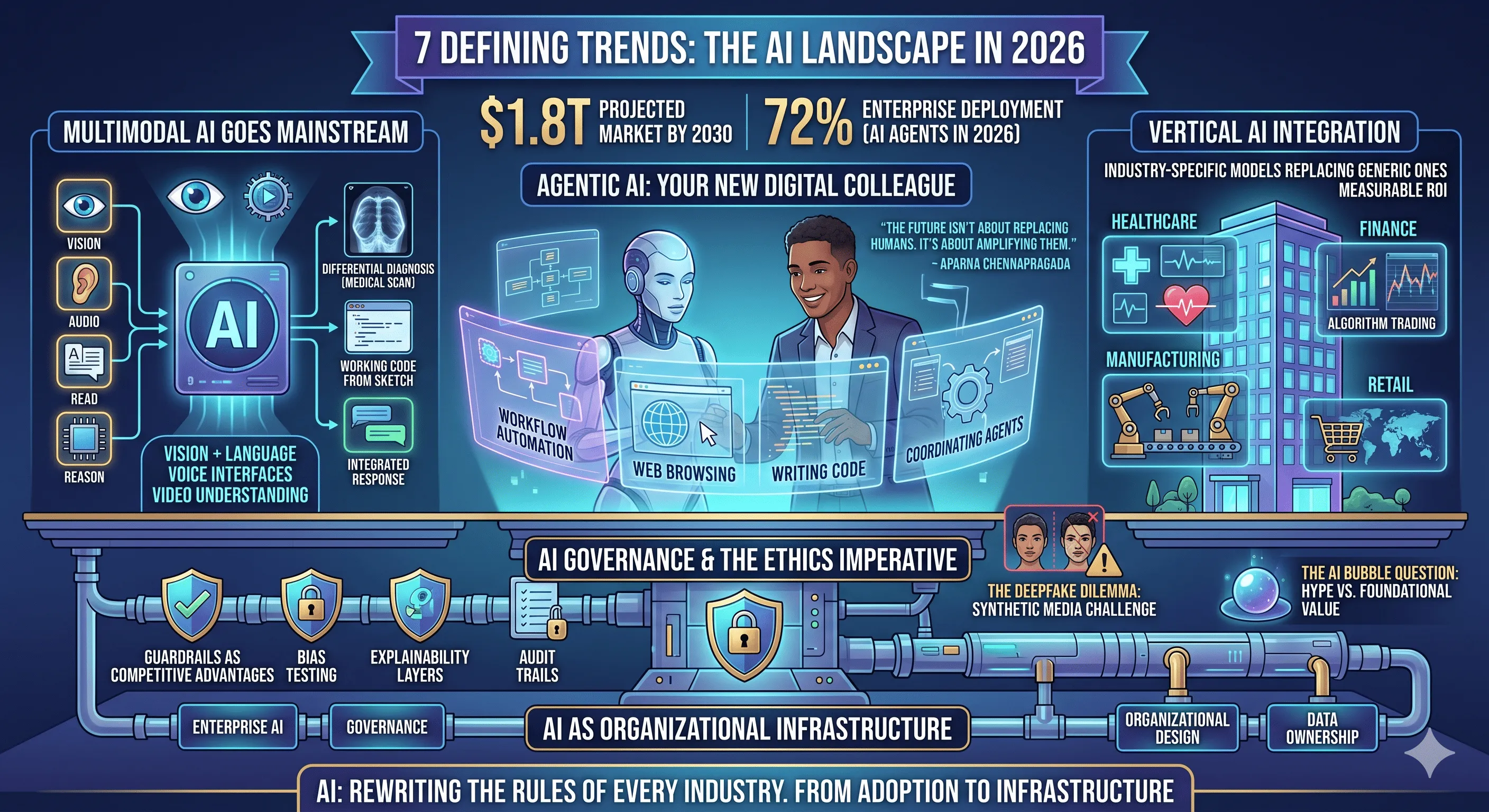
Rather than a single trajectory, Gartner's framework describes four distinct scenarios in which AI reshapes the workforce. Crucially, these aren't mutually exclusive — most organizations will experience all four simultaneously across different departments.
Gartner's Four-Scenario Framework
01
Fewer Workers Filling the GapsHumans do what AI can't. Work is mostly unchanged; AI handles the automatable portions, and people fill the rest.
02
Many Workers, Augmented and AcceleratedPeople do the same work — but faster and better, with AI as a powerful co-pilot. Productivity multiplies.
03
Innovation at the FrontierAI and humans collaborate to do things previously impossible — deep research, cross-disciplinary breakthroughs, combinatorial creativity.
04
Autonomous-First OperationsAI runs significant parts of the business with minimal human involvement in execution, though humans govern, shape, and scale.
The ripple effects of each scenario extend well beyond the obvious. Even Scenario 4 — the most autonomous — still requires humans to govern, trust-audit, and strategically direct the systems. Gartner calls these downstream consequences "ripple effects": the unexpected workforce changes that cascade when AI becomes normalized in an organization.
The Skills That Survive — and Thrive
If AI is automating summarization, translation, and basic information retrieval, what does that mean for the humans who built careers around those tasks? The honest answer: some roles will shrink. But Gartner's research is clear that new, higher-value roles will emerge to replace them — provided organizations invest in the transition.
One counterintuitive finding from Gartner's supply chain research is the danger of halting entry-level hiring. A survey of 509 supply chain leaders found that 55% anticipate a decline in entry-level hiring due to agentic AI. Gartner warns this is a strategic error: by 2030, 75% of businesses that paused entry-level hiring in 2026 will face pay premiums of 15% or more for early-career talent, because the pipeline of future managers will have dried up.
"AI is not a 'plug and play' replacement for people. Organisations that stop hiring and fail to develop early-career professionals will soon face talent pipeline gaps, employee dissatisfaction and elevated hiring pay premiums."— Simon Bailey, VP Analyst, Gartner Supply Chain Practice
There's also the problem of skills atrophy. As workers rely more heavily on AI for cognitive tasks, Gartner warns that core human competencies — critical thinking, domain expertise, complex judgment — can quietly erode. The prescription: periodic skills testing to ensure workers are genuinely retaining their capabilities, not just offloading cognition to machines.
The Human Readiness Gap
One of the most striking findings from Gartner's Global Labor Market Survey — conducted in Q1 2026 across 12,004 employees and managers in 40 countries — is how unprepared most organizations are, despite years of AI investment. Only 27% of executives report having a comprehensive AI strategy. Only 20% believe their workforce is truly AI-ready. And 19% of employees report no time saved from AI at all.
Gartner calls this the "enablement illusion": leaders tracking hours saved as a proxy for transformation, while the deeper cultural and structural shifts go unaddressed. AI adoption, it turns out, is as much a culture problem as a technology problem. Standard software training doesn't move the needle on workforce sentiment or trust.
The data point that should matter most to every leader: employees with a positive outlook toward AI are 3.4 times more likely to be highly productive. Fear is a productivity killer — and right now, fear is widespread.
❧
What This Means for You
Gartner's long-term forecast is ultimately an optimistic one: by 2028–2029, autonomous business will be a net-positive job creator. By 2036, AI could generate more than 500 million net new human jobs globally. The demographic pressures of aging populations, the irreplaceable value of human trust in high-stakes moments, and the governance demands of autonomous systems all ensure humans remain central to the economy.
But the path from here to there isn't automatic. Organizations that cut their way to AI returns will find themselves talent-poor and strategically exposed. The ones that invest in amplifying their people — equipping them to guide, govern, and grow alongside autonomous systems — will be the ones that look back on this period as a competitive turning point.
32 million jobs will be transformed every year, Gartner estimates, requiring upskilling or role redesign. That's not a future threat. For most industries, it has already begun.
Key Takeaways for Leaders
AI layoffs are not generating ROI — "people amplification" is the actual value driver.
By 2030, zero IT work will happen without AI involvement; prepare now for the human-AI collaboration shift.
Pausing entry-level hiring will create a talent shortage and 15%+ pay premiums by 2030.
Skills atrophy is a real risk — test and exercise human capabilities, not just AI tools.
Only 20% of workforces are AI-ready — employee confidence and transparency are the levers that change this.
AI creates a culture challenge as much as a technology one — adoption is driven by trust, not training.
The question was never whether AI would change work. It always was — and still is — whether organizations would have the wisdom to let it make their people more rather than fewer. The data from Gartner is unambiguous: the smarter bet is on amplification.
Sources
Gartner IT Symposium/Xpo Keynote, Barcelona, November 2025 · Gartner Press Release: Autonomous Business & AI Layoffs, May 2026 · Gartner Global Labor Market Survey, Q1 2026 (12,004 respondents, 40 countries) · Gartner Supply Chain Symposium/Xpo, Orlando, May 2026 · Gartner Research: "AI Won't Cause a Jobs Apocalypse, but It Will Unleash Job Chaos", Nov 2025
This blog post synthesizes publicly available Gartner research and analyst commentary for informational purposes.




Comments