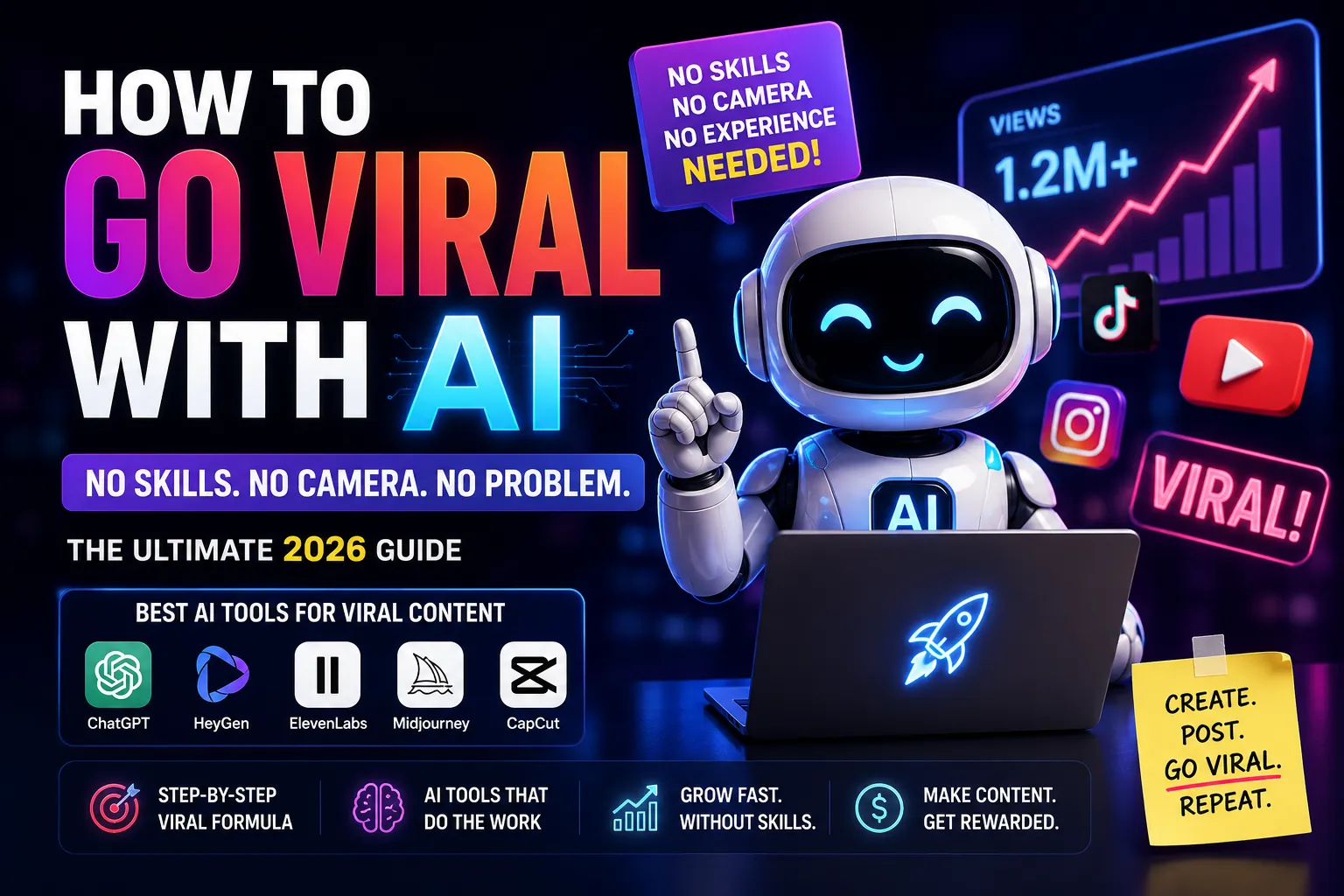
What if you could create viral content — reels, threads, blog posts, and YouTube scripts — without being a writer, designer, or video editor? In 2026, that's not a dream. It's Tuesday.
AI has completely rewritten the rules of the creator economy. And the best part? The people winning the biggest audiences right now are often the ones with zero prior experience. They just know how to prompt.
This guide is your complete, no-fluff roadmap to going viral with AI tools — from ideation to distribution — even if you're starting from scratch today.
Why AI changes everything for creators
Before AI, going viral required expensive gear, years of practice, a big network, or plain luck. Now, the barrier has collapsed. AI handles the hardest parts — ideation, writing, visuals, editing — in seconds. You provide the direction. The machine does the heavy lifting.
Step-by-step: go viral with AI
The AI tools worth actually using
The formula behind viral AI content
Viral content follows patterns. AI lets you execute those patterns at scale. The three elements every piece of viral content shares:
1. Strong emotional trigger
Surprise, curiosity, outrage, inspiration, or humour. Ask AI to amplify the emotional angle in your content before publishing.
2. Extreme specificity
"How I gained 10k followers in 30 days posting 3 AI reels per week" outperforms "how to grow on Instagram." AI helps you niche down the language automatically.
3. Frictionless format
Short, punchy, scannable. AI knows what performs on each platform — just ask it to format for TikTok, LinkedIn, or YouTube Shorts specifically.
Common mistakes to avoid
Using AI doesn't guarantee virality. These are the traps that kill traction:
Sounding robotic. Always read your AI-generated content aloud and edit it to sound like a real person. Add one personal observation or story every time.
Chasing every trend. Use AI to identify trends, but only create in niches you understand — authenticity still wins.
Publishing without an SEO layer. Every post needs a keyword-optimised title, description, and tags. AI can generate all three in under a minute.
Not posting consistently. AI removes the bottleneck of creation. Use that advantage. Post daily. Volume creates luck.
Final thought
The creator economy in 2026 rewards speed, specificity, and volume. AI gives you all three for free. The only skill you actually need is the willingness to start today and iterate daily.
Pick one platform. Generate one piece of content with AI right now. Publish it before you overthink it. That's how it begins.






Comments